Early history (source unknown): “First
called Boulder City. Elevation 5,535 ft. County seat of
Boulder County, located near foothills, in North Boulder
Valley on Boulder Creek; and principal station on the
Colorado Central Railroad and Denver and Boulder Valley
Railroad. Western Union and Atlantic & Pacific
Telegraph. Money order, telegraph and post-office. Daily
mail and express. Daily stage lines to Nederland, Caribou,
Central City, Sunshine, Salina, Jamestown, Magnolia and
Gold Hill. Population, 4,000. In 1871 population was 600,
1873–750, 1875–2,100, 1877–4,000. Agricultural valleys to
the North and South.”
Boulder remains the County seat and is the
home of the University of Colorado. The population has
grown to 94,673 (2000 US Census).
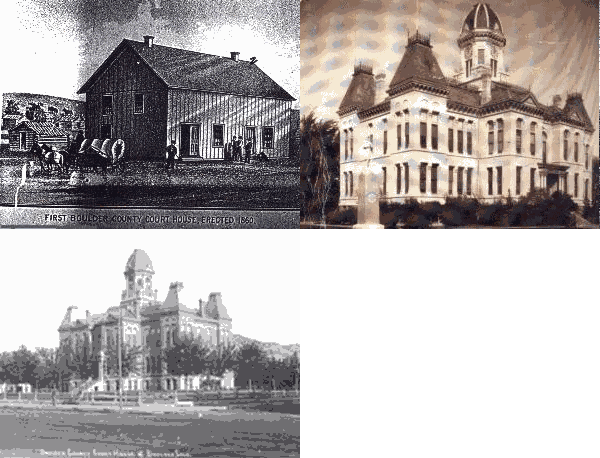
Below and
Right: The first Court House, erected 1860.
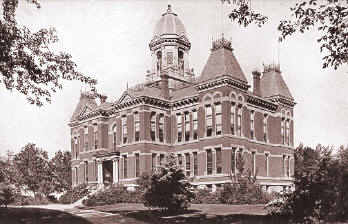
The second Court House in 1882, Pearl Street, Boulder.
Burned in 1932.
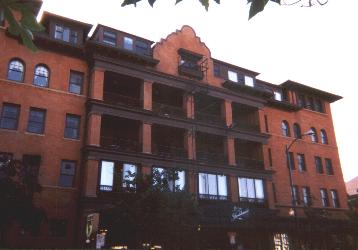
Boulderado
Hotel, Spruce Street
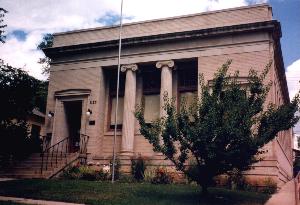
The
original Carnegie Library, now the Local History
Library
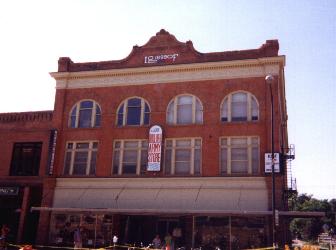
Masonic Building, once used
as the U.S. Post Office until the new one was
built. Now houses the Army Store. Located on
Pearl Street.
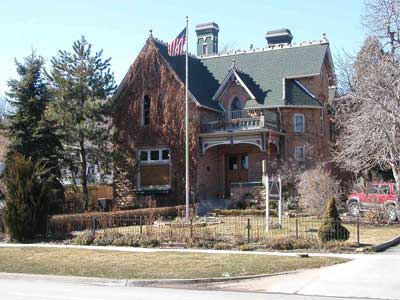
The Greene‑Earl House, 2429
Broadway, built 1882 in Gothic style. First occupied
by Oscar F. A. Greene, who moved to Boulder in 1872,
became City Attorney, and compiled the first set of
city ordinances in the Earl House library. In 1901,
it was sold to the Cooks, who enlarged it by two
rooms and a servants cottage. Later sold to Arthur
R. Couzens, founder of Mercantile Bank and Trust. In
1916 it was purchased by I. T. Earl, who lived there
for 50 years. Earl came from England in the late
1800s, arrived in Colorado after WWI, became a
cattle businessman with a ranch on Foothills
Highway, and served as Mayor of Boulder. The house
is currently transitional housing for youth with
behavioral or substance abuse issues.