DRY FARMING
The conditions for farming on the Plains are vastly different from what
they are in the East. The proverb says: "When in Rome, do as the
Romans do." For years eastern farmers have employed eastern methods
on western soil and under western conditions. What has been done in the
past is, therefore, no standard of what may he or will be done in the
future; and yet, even under crude methods, the results have often been
astonishing. According to the report of the National Bureau of
Agriculture, all products of the soil in Colorado show a greater yield per
acre than any other state in the Union.
In 1893, the farmers of Colorado were called upon to make exhibits at
the World's Fair at Chicago, as were the farmers of all the agricultural
states. These exhibits revealed the fact that in this state 277 varieties
of wheat were grown, fifty varieties of oats, and 125 varieties of native
grasses. Twenty-five awards were given to the wheat exhibit alone of
Colorado; the largest number received by any state or country whatsoever.
 In
the past the best results have been obtained through irrigation. Within
recent years farmers in eastern Colorado have begun to experiment with the
Dry Farming System, or, as it is often called, from its chief exponent,
Prof. W. H. Campbell, of Lincoln, Nebraska, "The Campbell System."
In
the past the best results have been obtained through irrigation. Within
recent years farmers in eastern Colorado have begun to experiment with the
Dry Farming System, or, as it is often called, from its chief exponent,
Prof. W. H. Campbell, of Lincoln, Nebraska, "The Campbell System."
Experience elsewhere has shown that it is possible to mature crops on a
rainfall of twenty inches a year, though a larger amount is to be desired
for the best results. It is practical to farm successfully in a country
having no more than twelve inches of rainfall in twelve months by the
storage of water in the soil through the Dry Farming System. The
principles of this farming are the conservation of moisture and intensive
methods of culture.
 The
first step in Dry Farming is deep plowing at the proper time. The ground
plowed should be packed the same day to prevent evaporation, by a
subsurface packer -- an implement with ten wedged-shaped wheels which cut
the soil and press it together. Then the ground is to be smoothed down by
a harrow. After every rain the field is again harrowed, forming a dry
blanket of earth and preventing evaporation. Thus all moisture that falls
is conserved, and as it rises by the capillary attraction is available for
absorption by the growing plants.
The
first step in Dry Farming is deep plowing at the proper time. The ground
plowed should be packed the same day to prevent evaporation, by a
subsurface packer -- an implement with ten wedged-shaped wheels which cut
the soil and press it together. Then the ground is to be smoothed down by
a harrow. After every rain the field is again harrowed, forming a dry
blanket of earth and preventing evaporation. Thus all moisture that falls
is conserved, and as it rises by the capillary attraction is available for
absorption by the growing plants.
So much as to the theory. The question rises, How does it work?
Preceding figures have shown how Colorado as a state stands among the
grain countries of the world. What place does Dry Farming hold in
Colorado? The answer can be found in the records of the Colorado State
Fair for 1906.
 At
that fair Dry Farming was awarded first prizes for the following exhibits:
for the best spring wheat; for the best field corn; for Early Ohio
potatoes; for Irish potatoes; for Peach Blow potatoes; for broom corn; for
onions. Second prizes were given to Dry Farming for Australian corn and
Early Rose potatoes.
At
that fair Dry Farming was awarded first prizes for the following exhibits:
for the best spring wheat; for the best field corn; for Early Ohio
potatoes; for Irish potatoes; for Peach Blow potatoes; for broom corn; for
onions. Second prizes were given to Dry Farming for Australian corn and
Early Rose potatoes.
In this country it has been customary to take land on which corn has
grown, go over it with discs and sow the wheat without plowing. When once
the farmer understands his soil it would seem that the average yield would
be at least doubled.
A specific instance of what is being done in this vicinity is an
illustration of what, perhaps, all could do. William S. Callaway, living
twelve miles southwest of Wray, and near Vernon, has tried successfully
the summer fallowing system of Dry Farming. Following is part of a letter
written by Mr. Callaway to the Ranch and Range, a farming paper
published in Denver, 401-2 Commonwealth building, under date of February
15, 1907:
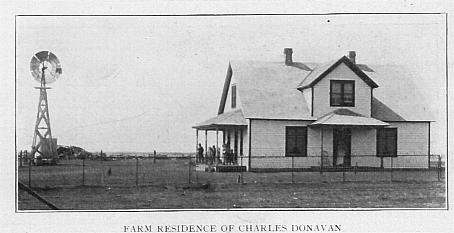
Vernon, Col., Feb.15, 1907. Editor Ranch and Range, Denver,
Colorado:
In giving you my experience as a farmer, I shall commence from the
beginning, which dates back to the spring of 1886. Coming from eastern
Nebraska to this, what was then a trackless waste of prairie, with not
enough money to live on over two or three months like a good many more in
those times, we were compelled to hunt buffalo bones for a living. We
tried farming as we were accustomed to doing back East, which was the
cause of several successful failures, but like grim death we held on
through thick and thin. Some years very good crops; only one year in
twenty have we made a complete failure, which was the year 1894, one load
of corn fodder being all we had to show for our summer's work. Will say
here that we have made our living since coming here by farming.
In farming the old or common way our crops have run in spring as
follows: Wheat, from 13 to 27 bushels; oats, 20 to 65 bushels; barley, 20
to 45 bushels; and corn, 8 to 27 bushels. A living can be made with these
results if one is contented to plod away with no other aim in view aside
from a living.
Having read some on the Campbell system, I determined to try it as a
side issue or experiment, besides keeping up the old way of farming.
A review of his experiment, and the results as given in the Beecher
Island ANNUAL for 1906, are as follows:
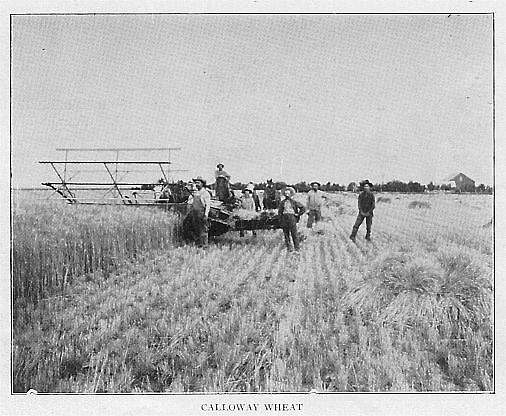 Mr.
Callaway had 64 acres in one field which he prepared and planted by three
methods, which will be considered separately -- each piece being a little
over 21 acres. The first piece, or the Campbell method of cultivation as
we shall term it, was first listed in May, 1905, as if corn was to be
planted; however, no seed was put in. Then in June this ground was
re-listed, that is, the ridges of the former listing were split. The
ridges of the second listing were then leveled down with a disc
cultivator, then dragged and disced. After this the ground was disced
after a hard rain and harrowed after a light rain until September 10, when
it was sown to turkey red wheat with a press drill, at one-half bushel per
acre. Nothing more was done with this piece of wheat until it was cut and
bound from the 8th to the 10th of July, and threshed out of shock on
August 4. The yield, machine measure, was 56 1/7 bushels per acre, which
overrun 6 pounds per bushel and tested 64, which made a yield by weight of
61 2/3 bushels. The same method employed in 1905 yielded 48 bushels per
acre, while spring wheat grown beside it only turned out 7 1/2 bushels per
acre.
Mr.
Callaway had 64 acres in one field which he prepared and planted by three
methods, which will be considered separately -- each piece being a little
over 21 acres. The first piece, or the Campbell method of cultivation as
we shall term it, was first listed in May, 1905, as if corn was to be
planted; however, no seed was put in. Then in June this ground was
re-listed, that is, the ridges of the former listing were split. The
ridges of the second listing were then leveled down with a disc
cultivator, then dragged and disced. After this the ground was disced
after a hard rain and harrowed after a light rain until September 10, when
it was sown to turkey red wheat with a press drill, at one-half bushel per
acre. Nothing more was done with this piece of wheat until it was cut and
bound from the 8th to the 10th of July, and threshed out of shock on
August 4. The yield, machine measure, was 56 1/7 bushels per acre, which
overrun 6 pounds per bushel and tested 64, which made a yield by weight of
61 2/3 bushels. The same method employed in 1905 yielded 48 bushels per
acre, while spring wheat grown beside it only turned out 7 1/2 bushels per
acre.
The second piece of wheat, same seed, and on ground beside the first
piece, was on fall plowed ground, drilled in at the same time as the first
piece, sown one-half bushel per acre, cut and bound from July 8 to 10,
threshed out of shock August 4, yielded 27 bushels per acre, machine
measure, overrun 5 pounds per bushel, tested 63, making a yield of 29
bushels by weight per acre.
 The
third piece was double disced twice, or disced four times, harrowed and
planted with press drill in stubble ground beside the above pieces in
September, cut and bound July 8 to 10 and threshed out of shock August 4.
Yield per acre was 21 3/4 bushels, machine measure, overrun 5 pounds per
bushel, test 63, making a yield per acre of 24 bushels by weight.
The
third piece was double disced twice, or disced four times, harrowed and
planted with press drill in stubble ground beside the above pieces in
September, cut and bound July 8 to 10 and threshed out of shock August 4.
Yield per acre was 21 3/4 bushels, machine measure, overrun 5 pounds per
bushel, test 63, making a yield per acre of 24 bushels by weight.
Here you have a fair test of the so-called Campbell system, although not
fully carried out (the wheat not being harrowed or cultivated while
growing) as compared with other methods on the same kind of ground, same
seed, and same care from date of planting, the yield of 24, 29, and 61 2/3
bushels per acre by weight being the result.
 This
wheat received no irrigation, but was raised by the summer fallow or "Campbell
System" of farming, by William S. Callaway, Vernon, Colorado.
This
wheat received no irrigation, but was raised by the summer fallow or "Campbell
System" of farming, by William S. Callaway, Vernon, Colorado.
Twenty acres of this wheat yielded 56 1/7 bushels per acre, machine
measure, which weighed 66 pounds to the bushel and tested 64 pounds to the
bushel, making an actual yield by weight of 61 2/3 bushels.
State of Colorado,
County of Yuma.
I, William S. Callaway, do on oath depose and say that I raised the
wheat above described this season and the statements and weights as above
given are correct.
WM. S. CALLAWAY.
Subscribed in my presence and sworn to before me this 14th day of
August 1906.
MADISON FINCH, (SEAL)
Notary Public.
ALFALFA
Alfalfa is grown mostly in the river bottoms where irrigation is
possible, but this year twelve of the enterprising farmers of Wray have
begun a series of experiments with non-irrigated, high altitude,
Turkeystan alfalfa seed, planting this on the divides above irrigation.
The result of these experiments is being looked forward to with great
interest. The word alfalfa is derived from the Arabic, which means "the
best sort of fodder." Three or four crops a year, and from three to
six tons per acre, represent the harvest. Alfalfa is the best fat producer
for stock; it is a nitrogen gatherer, and by rotation of crops fertilizes
the soil. It produces a rich harvest for the bee. At the World's Fair at
St. Louis the grand prize for both comb and strained honey was given to
Colorado, and the honey was alfalfa honey.
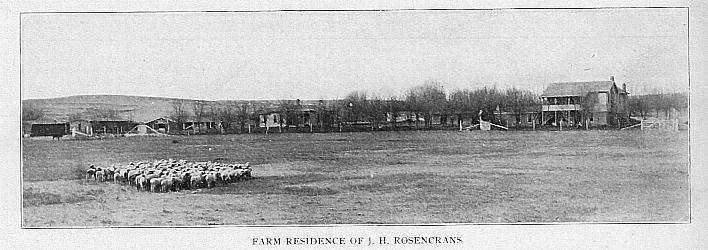
J. H. Rosencrans, sixteen miles southeast of Wray, has 300 acres in
alfalfa and many others have smaller acreage.
FRUITS AND VEGETABLES
 The
early settlers experienced considerable difficulty in getting fruit trees
to grow. Within recent years cherries, peaches, plums, apples, etc., have
been raised in small quantities. John Spiers, west of Wray told the writer
that a year ago he raised between sixty and seventy bushels of peaches,
about forty-five bushels of cherries, and some plums. The fruit in this
section is all of a fine flavor, and most of the farms now have their
orchards, which ought, with care, to furnish an abundance of fruit in two
or three years.
The
early settlers experienced considerable difficulty in getting fruit trees
to grow. Within recent years cherries, peaches, plums, apples, etc., have
been raised in small quantities. John Spiers, west of Wray told the writer
that a year ago he raised between sixty and seventy bushels of peaches,
about forty-five bushels of cherries, and some plums. The fruit in this
section is all of a fine flavor, and most of the farms now have their
orchards, which ought, with care, to furnish an abundance of fruit in two
or three years.
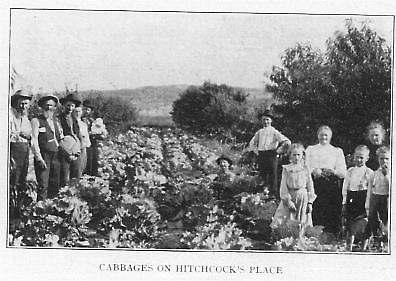
Vegetables and melons of all kinds grow to perfection. The writer has
lived many years in the south, which is sup posed to be the home of the
melon, but he never saw or tasted finer than are grown in this section.
HOGS
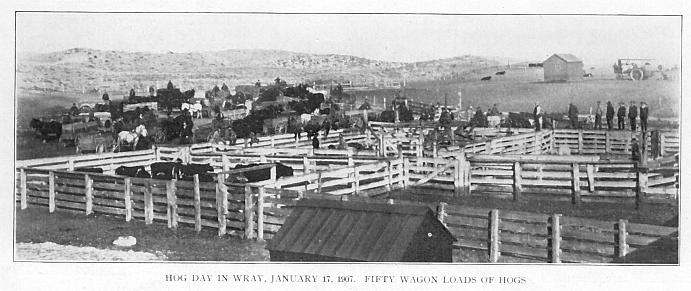
The raising of hogs is a neglected industry in Colorado. The city of
Denver requires over 100,000 for pork every year. According to statistics
for 1907 in the Ranch and Range, the Denver packing-houses can use
this number every month. Last year only 17,000 were received from
Colorado. The neighborhood around Wray is remarkably well adapted to the
raising of swine. No diseases are known, and the alfalfa and corn are
abundant.
Milt Briggs, three miles south of Wray, raises hogs more abundantly
perhaps than any in the section. Last year Mr. Briggs captured two first
prizes, two seconds, and one third. He raises the Chester White.
[ Prev | Index
| Next ]