SOIL
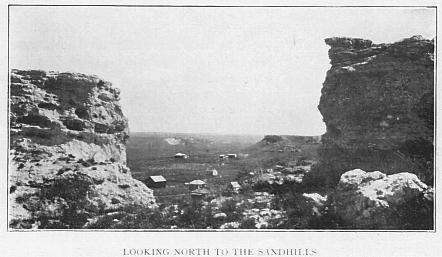 The
country in this vicinity falls into two natural divisions: sandhills and
the Flats. The sandhills at Wray are just across the Republican River.
They follow the form of a bent bow, running from the northeast to the
southwest. The North Fork of the Republican is for some miles the backbone
of the bow. The Middle Fork, or Arikaree River, is the string. The country
lying between constitutes the Flats, or divide, which is today covered
with prosperous farms.
The
country in this vicinity falls into two natural divisions: sandhills and
the Flats. The sandhills at Wray are just across the Republican River.
They follow the form of a bent bow, running from the northeast to the
southwest. The North Fork of the Republican is for some miles the backbone
of the bow. The Middle Fork, or Arikaree River, is the string. The country
lying between constitutes the Flats, or divide, which is today covered
with prosperous farms.
Speaking of this divide, Bulletin 77, February, 1903 of the Agricultural
Station of the Agricultural College of Colorado at Fort Collins, says "The
region between the Arikaree and the North Fork of the Republican river,
lying east of the sandhills, appears like a piece of country taken from
two hundred miles east of its present location and set down in eastern
Colorado." The land is thus considered by experts to be similar to
the best land of Kansas and Nebraska.
 These
sandhills exert considerable influence on this particular region. They
serve to protect the country from the hot winds which are often found in
other places. Bulletin 89, June, 1904, from the same experiment station,
observes: "The Vernon divide is protected from the ravages of hot
winds by the sandhills that lie on the northern and western sides of it.
The influence of the sandhills dwindles rapidly as the location is farther
to the south and east.
These
sandhills exert considerable influence on this particular region. They
serve to protect the country from the hot winds which are often found in
other places. Bulletin 89, June, 1904, from the same experiment station,
observes: "The Vernon divide is protected from the ravages of hot
winds by the sandhills that lie on the northern and western sides of it.
The influence of the sandhills dwindles rapidly as the location is farther
to the south and east.
By the time Burlington is reached the influence of the sandhills is
nothing. . . These sandhills absorb all the water that falls on them. They
also receive in addition the drainage from about as large an area as they
cover, which lies west of them. . . This moisture influences the humidity
of the area which the hills partially surround, and while the rainfall is
practically the same at Wray as at Cheyenne Wells, the air is more humid
and so does not absorb the water from soil and from the vegetation so
rapidly as does the air in less protected localities."
 It
will thus be observed that, besides serving as a barrier against hot winds
that sweep across the prairies, these sandhills are natural reservoirs of
water. No matter how prolonged the drought, the sand a few inches below
the surface is always moist. This moisture, by its constant evaporation,
keeps the air humid. It is a well-authenticated fact that rain clouds
follow watercourses. It would seem, therefore, that these sandhills exert
no little influence in producing that rainfall which is found to a greater
degree in this vicinity than in the surrounding country. Wray and Vernon
are in what is known as the rain belt, and no irrigation is employed
except on the river bottoms.
It
will thus be observed that, besides serving as a barrier against hot winds
that sweep across the prairies, these sandhills are natural reservoirs of
water. No matter how prolonged the drought, the sand a few inches below
the surface is always moist. This moisture, by its constant evaporation,
keeps the air humid. It is a well-authenticated fact that rain clouds
follow watercourses. It would seem, therefore, that these sandhills exert
no little influence in producing that rainfall which is found to a greater
degree in this vicinity than in the surrounding country. Wray and Vernon
are in what is known as the rain belt, and no irrigation is employed
except on the river bottoms.
The land on the plains is mostly all good. It is the presence or absence
of water which makes it valuable or worthless. Wray, Colorado:
"Little Drops of water, on little grains of sand, Make a mighty
difference In the price of Western land."
If water be plenty the land is good for farming. If water be scarce, it
is good only for grazing or for nothing.
Below is a table showing precipitation for the last seven years, as
taken by I. C. Tuomey, Voluntary Observer, at Wray, Colorado:
|
1900 |
1901 |
1902 |
1903 |
1904 |
1905 |
1906 |
| January |
.16 |
.00 |
.40 |
.25 |
.00 |
.04 |
.55 |
| February |
.00 |
1.07 |
.90 |
1.98 |
.58 |
.05 |
.62 |
| March |
.38 |
2.51 |
1.15 |
.16 |
.63 |
3.10 |
1.88 |
| April |
2.50 |
4.62 |
.74 |
.54 |
2.28 |
5.12 |
4.59 |
| May |
1.51 |
1.44 |
7.00 |
1.75 |
2.02 |
2.59 |
3.20 |
| June |
2.35 |
3.44 |
5.69 |
1.55 |
6.25 |
3.19 |
2.57 |
| July |
4.53 |
2.05 |
3.33 |
5.16 |
2.10 |
2.98 |
1.62 |
| August |
2.64 |
5.36 |
2.71 |
1.48 |
1.26 |
.93 |
1.62 |
| September |
.15 |
2.11 |
3.72 |
.69 |
1.44 |
2.19 |
1.71 |
| October |
.03 |
.43 |
1.05 |
.34 |
1.10 |
1.64 |
1.43 |
| November |
.20 |
.00 |
.16 |
.25 |
.05 |
.60 |
.53 |
| December |
.40 |
.00 |
.59 |
.00 |
.20 |
.60 |
.29 |
| Totals |
14.80 |
22.43 |
27.45 |
14.15 |
17.61 |
22.43 |
23.09 |
A study of the above table will show that we have our greatest
precipitation during the spring and summer months, and that the average
for the past seven years has been 20.28 inches.
[ Prev | Index |
Next ]