a proud part of the USGenWeb Project

|
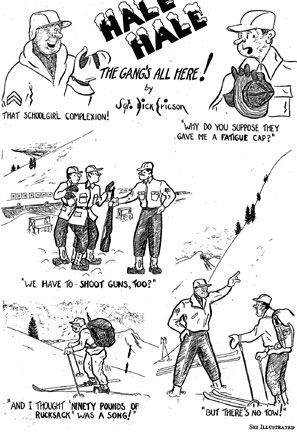
Three weeks after the activation of the 87th, came the action that pushed America into World War II: planes from Japanese carriers attacked Pearl Harbor on December 7, 1941. Unfortunately, every officer in the 87th at Fort Lewis?including the commander?was new to winter and mountain warfare except German-speaking recruits. The considerable contingent of Germans, Austrians and Swiss enlisted in the 87th had all trained in mountain warfare since the age of 18 in their nation's mountain troops. But the U.S. Army was not about to accept immigrants as officers, no matter how experienced in mountain warfare. The 10th Mountain Division was activated in 1943, based at the training camp constructed at Pando, Colorado. The move to Pando was messy, the training sometimes confusing. The cartoons of Corporal L. Christian and Sergeant Dick Ericson in the February 1944 Ski Illustrated were on the mark in reflecting the average 10th Mountain recruit's apprehensions and misapprehensions. After the war in Europe was over, three 10th Mountain men?Friedl Pfeifer, Johnny Litchfield and Percy Rideout?joined forces in Aspen, Colorado. In 1945, they surveyed the mountain, cut trails and staffed the three-man ski school. In the spring of 1946, Pfeifer landed the backing needed to install two chairlifts he had ordered for the 1946-47 winter. From there on, Aspen succeeded against all odds in becoming the leading American high-mountain resort with the help of several squadrons of loyal 10th men holding down various posts within the resort. Without the 10th Mountain, Aspen would not have happened. |
|
|
REFERENCES Source: February 1944 Ski Illustrated |
|
This page was last updated
Please to not ask for specfic research on your family. I am unable to do your personal research.